
01
Real sensor projects
Soil moisture for smart irrigation, MQ sensors for air quality, ultrasonic for distance: students build systems that solve problems they recognise from daily life.
Grades 5–8 · Arduino track
Where robotics meets the real world.
The Grobots Robotics & AIoT Kit is an Arduino Nano kit for Grades 5–8 that takes students from "make a robot move" to "make a system that senses and responds", with nine sensors, a dual motor driver and an OLED display, coded in blocks and then the Arduino IDE.
It powers genuine IoT and automation projects: smart irrigation, air-quality monitors, clap-activated robots. Students start in block coding and graduate to the Arduino IDE (C++), the platform professionals actually use, supported by 40+ graded activities.
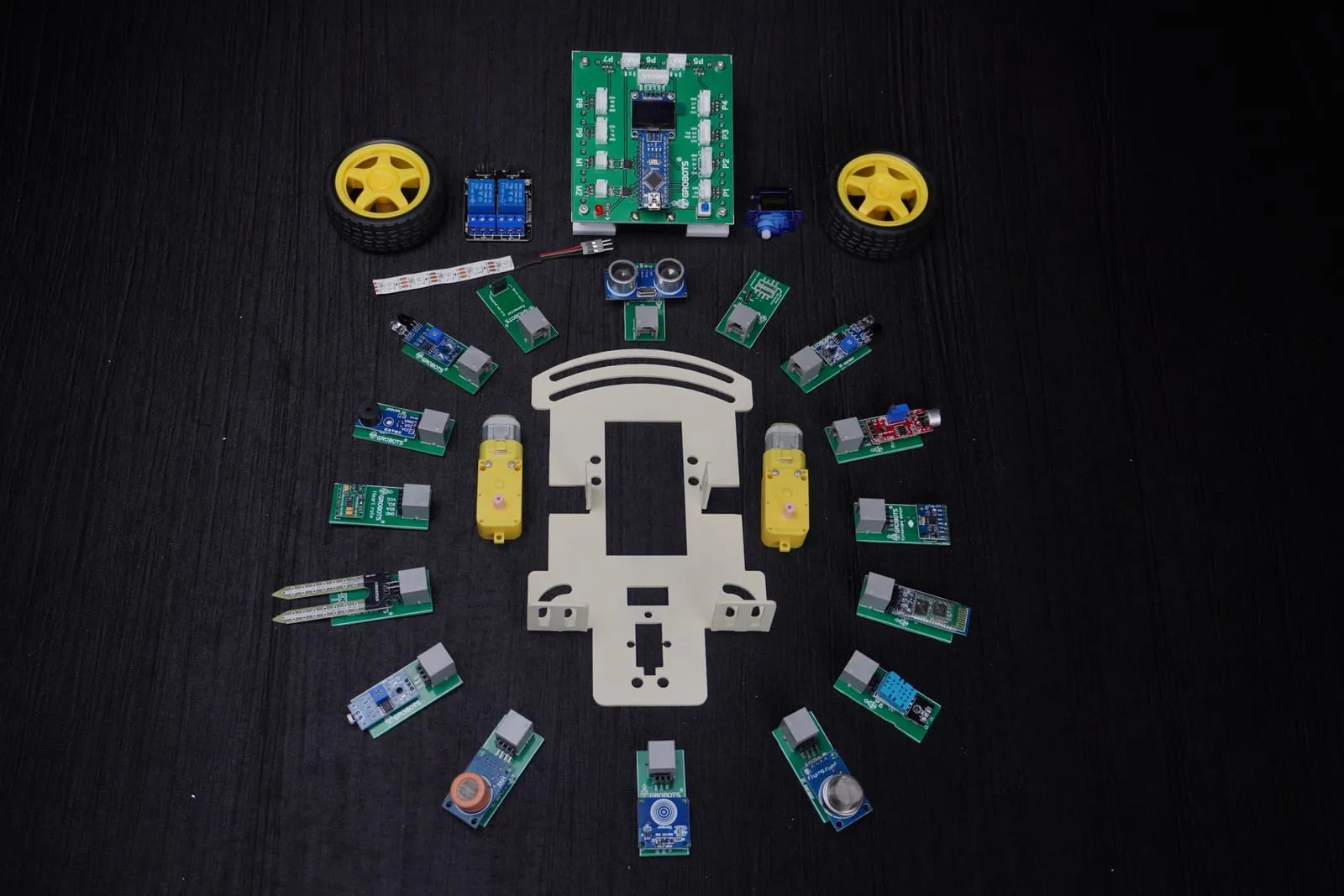
This kit comes inside a lab, not sold on its own. The AIoT Kit comes inside a Grobots lab, often blended with the core pathway in a Composite Skills, STEM or innovation lab. Your own teachers run it (School-Run Lab), or a Grobots trainer runs it on campus (Managed Lab).
See the Composite Skills Lab →What it builds
AIoT is where students learn that a machine can read its environment and respond: the foundation of everything from home automation to industrial IoT.
01
Soil moisture for smart irrigation, MQ sensors for air quality, ultrasonic for distance: students build systems that solve problems they recognise from daily life.
02
Students begin in a friendly block environment and step up to the Arduino IDE in C++, the same toolchain used by professional embedded engineers worldwide.
03
With a dual motor driver, servo, relay and metal chassis, students assemble driving robots and automated systems, then program the logic that runs them.
The controller
An Arduino Nano core with everything a classroom IoT project needs built onto the board.
In the kit
Nine sensors and a full actuator set, plug-and-play over RJ11 and JST, with no loose wiring.
Connectors and software
Connectors
Every sensor module plugs into the AIoT Controller over RJ11 or JST, so students build real IoT systems without breadboards or loose jumper wires. Open circuit-building comes later, on the Arduino Tinker Kit.
Software
Students start in block-based coding and move to the Arduino IDE gradually, with the Virtual Master Trainer's video for every lesson. Nobody needs to know C++ on Day 1.
Where it fits
AIoT is the Arduino-based track for schools focused on IoT, automation and real-world sensing. It complements the micro:bit pathway and leads naturally to the Arduino Tinker Kit.
Grades 3–5
Grobots Primo Coding foundationYou are here
Robotics & AIoT Grades 5–8 · Arduino and sensorsGrades 7–9
Arduino Tinker Electronics and prototypingMore than the kit
20–24 sessions per grade, every year, with defined outcomes for each lesson. Four guided lessons, then every fifth session is a Challenge that doubles as the assessment.
A teacher video for every lesson, in English, Hindi and Marathi, plus a printed workbook for students.
Your teacher is trained on the sensors, the controller and the block-to-Arduino IDE flow.
Grobots designs and makes its kits in India. Spares and replacements come from the same team that built them.
Questions schools ask
AIoT is built on the Arduino Nano and takes students to the Arduino IDE (C++), with a sensor suite geared toward IoT and automation. The Ultima kits run on micro:bit V2 and lead to MicroPython and AI vision. Many labs run both tracks; we'll advise based on your goals and timetable in the proposal.
It suits Grades 5–8. The exact placement depends on your lab's session length and where students are in their coding journey: a school that already runs Primo can start AIoT in Grade 5, while others bring it in a little later. We map it to your grades for you in the proposal.
No. Students start in block-based coding and move to the Arduino IDE gradually, supported by 40+ graded activities and the Virtual Master Trainer's video for every lesson. By the time they write C++, they already understand the sensors, motors and logic they are controlling.
No. The AIoT Kit comes as part of a complete Grobots lab, with the curriculum, onsite teacher training, the Virtual Master Trainer and support. Tell us your goals, and we'll show how it fits alongside the core pathway in a proposal.
The AIoT Kit comes as part of a complete Grobots lab, with the curriculum, training and the Virtual Master Trainer. Tell us your goals for a proposal within 24 hours.