CBSE Skill Education 2026-27: A Complete School Guide
CBSE skill education is now two separate obligations, not one. Classes 6–8 must run Kaushal Bodh, 110 hours a year of hands-on project work, directed by Circular No. Skill-81/2025 while Classes 9–12 choose from CBSE's list of elective skill subjects, and every affiliated school needs a Composite Skill Lab in place by 22 August 2027 under Circular Skill-75/2024.
Most school teams know one of those three things and are surprised by the other two. Every circular number, hour count and weightage below is taken from CBSE's own documents rather than from summaries and where the paperwork is genuinely ambiguous, we say so.
The three layers of CBSE skill education
Think of it as a stack. Each layer has a different legal character, and confusing them is how schools end up either over-buying or missing a deadline.
Layer 1 - Classes 6 to 8: Kaushal Bodh (mandatory)
Status: mandatory for every affiliated school
Instrument: Circular No. Skill-81/2025, dated 28 October 2025
Load: 110 hours per year, approximately 160 periods
Assessment: internal only, marks added to the final examination
Layer 2 - Classes 9 and 10: skill subjects (elective)
Status: optional, but widely adopted - taken as an additional sixth subject
Choice: 22 skill subjects in the 2026–27 list, codes 401 to 422
Marks: 50 theory + 50 practical for every subject on the list
Compulsory companion: Employability Skills, common across all sectors
Layer 3 - the Composite Skill Lab (mandatory, with a date)
Status: mandatory infrastructure
Instrument: Circular No. Skill-75/2024, dated 27 August 2024
Deadline: 22 August 2027
CBSE's own indicative figure: ₹3–6 lakh, described in the guidelines as suggestive only
Layer 1 is a timetable problem. Layer 2 is a staffing and board-exam problem. Layer 3 is a capital problem with a hard date. They are usually owned by three different people in a school, which is exactly why they drift apart.
Classes 6 to 8: what Kaushal Bodh actually requires
Kaushal Bodh is NCERT's pre-vocational textbook series for Classes 6, 7 and 8, and CBSE has made its implementation mandatory. The circular's annexure is short and unusually specific, so it is worth reading literally.
The mechanics, straight from the annexure
Curriculum load: 110 hours a year, roughly 160 periods, aligned to NCF-SE 2023
Timetable shape: two consecutive periods, twice a week, excluding examination time
Projects: three per class, one for each of the three forms of work
Cumulative total: nine projects completed by the end of Class 8
Menu: each textbook carries six projects, two per form of work; the school picks one per form, per class
Schools may design their own projects using the guidance in Annexures 1–3 of the textbook
The three forms of work, in CBSE's phrasing, are work with life forms, work with materials and machines, and work providing human services. This is the same organising idea that structures the Composite Skill Lab tool lists, which is why the two mandates are more connected than they look.
One line in the annexure settles a lot of staffroom arguments: the emphasis is on students acquiring the skills to do the project and learning from the doing, not on the end product. A wobbly stool a child actually built is the intended outcome. A perfect stool bought from the market is not.
The date discrepancy inside Skill-81/2025
The circular contradicts itself. The covering letter instructs schools to implement the textbooks immediately, in the present session, i.e. 2025-2026. The annexure attached to that same circular is headed as guidelines effective from the Academic session Year 2026-27, and its first line puts the rollout in 2026-27.
Both readings are defensible. The practical position: treat 2026–27 as the full operating year with the complete 110-hour timetable and project cycle, and keep evidence of whatever you ran in 2025–26 so you can show continuity rather than a standing start. Do not let a vendor use the earlier date to manufacture urgency.
How Kaushal Bodh is assessed
CBSE gives a suggested weightage scheme, and it is deliberately weighted away from written tests. Build your rubric around it from day one, because retrofitting portfolios in March is miserable.
Written test: 10%
Oral presentation or viva voce: 30%
Activity book: 30%
Portfolio: 10%
Teachers' observations during activities: 20%
Summative assessment happens at the end of each project. CBSE also advises a Kaushal Mela, a skill fair, at the end of the academic year. Treat that as the date that makes the rest real: a deadline parents are invited to is the only one that never slips.
Who teaches it
CBSE does not ask you to hire. Schools designate project teachers from the existing pool of academic teachers, chosen by subject alignment or personal interest, with any dedicated vocational teacher complementing them; CBSE has committed to training them with NCERT and PSSCIVE. From our own teacher-enablement work across school labs, willingness predicts success better than subject match, the art teacher who wants this will outperform the science teacher who was assigned it.
Classes 9 and 10: the 22 skill subjects
For 2026–27, CBSE's secondary skill subject list runs from code 401 to 422. Every one of them carries 50 theory marks and 50 practical marks, and each maps to a named job role from the relevant Sector Skill Council.
Technology and analytics
402 Information Technology: the most widely offered subject on the list
417 Artificial Intelligence
419 Data Science
420 Electronics and Hardware
415 Multi Media
422 Design Thinking and Innovation
Services and commerce
401 Retail · 405 Introduction to Financial Markets · 411 Banking and Insurance
406 Introduction to Tourism · 410 Front Office Operations · 412 Marketing and Sales
407 Beauty and Wellness · 413 Health Care · 403 Security
Production and applied sciences
404 Automotive · 408 Agriculture · 409 Food Production
414 Apparel · 416 Multi Skill Foundation Course
418 Physical Activity Trainer · 421 Foundation Skills for Sciences
416 Multi Skill Foundation Course is the natural continuation after three years of Kaushal Bodh, because it keeps the breadth rather than forcing early specialisation. And a skill subject taken as the sixth subject can replace a failed core subject in the Class 10 result calculation, which is why uptake keeps climbing regardless of the lab conversation.
At Classes 11 and 12 the list is separate and considerably longer, with Artificial Intelligence appearing as code 843. It is revised more often than the secondary list, so check the current version on CBSE's Skill Education page before printing anything for parents.
What CBSE charges for all this: nothing
Printed at the bottom of the official skill subjects list, in capitals: no fee is payable by the school to the Board for offering any skill module or skill subject, or for downloading any certificate. If anyone quotes you a CBSE registration or certification fee, that money is not going to CBSE.
Your real costs are teacher time, project consumables and the lab. Consumables are the line schools consistently forget - nine hands-on projects across three years, for every child in the middle school, is a recurring materials budget, not a one-time purchase.
The lab question: what Kaushal Bodh actually needs
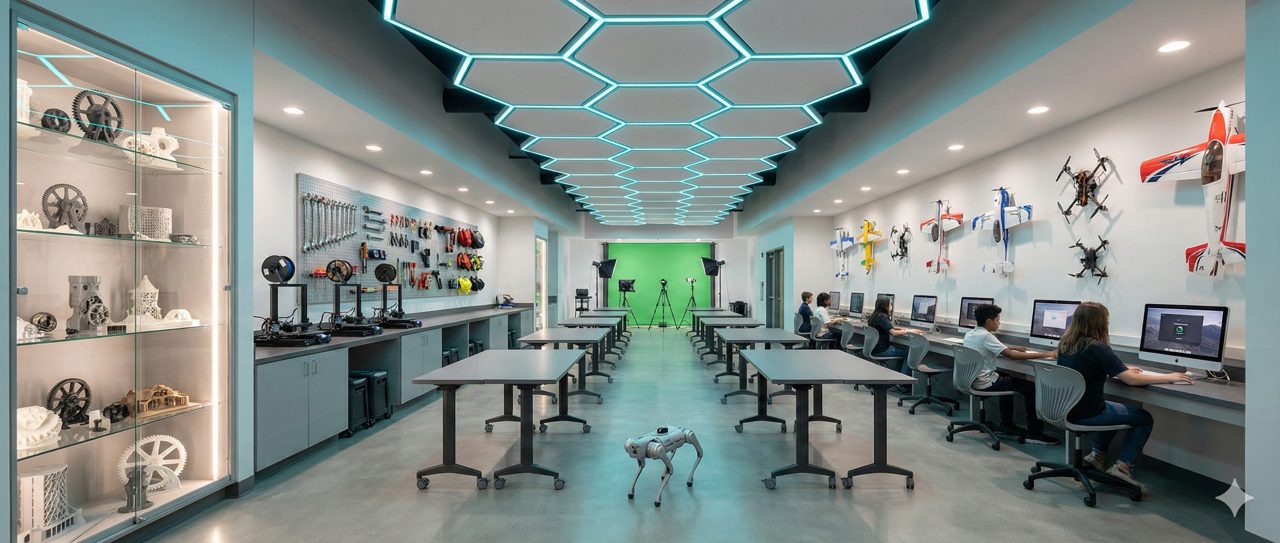
The honest answer is not the one most vendors give. The Skill-81/2025 annexure says schools with a Composite Skill Lab or other relevant lab may use those tools, and that schools may procure the tools a project needs, to be folded into the CSL later. It also explicitly invites schools to design projects around local vocations and take students on field visits.
In other words: Kaushal Bodh does not require you to build a lab first. Class 6 projects can run on a shared table with hand tools and locally sourced materials. What you cannot do is ignore the 2027 CSL deadline, which is a separate obligation under Skill-75/2024 and applies whether or not your Kaushal Bodh projects need it.
So the money-saving sequence is the reverse of the usual pitch: start Kaushal Bodh now with minimal kit, note which tools your teachers keep reaching for, then buy those tools as part of the CSL build, instead of buying a lab first and discovering your projects use a third of it. Our Composite Skill Lab cost breakdown, the CSL setup guide and the Skill-75/2024 explainer cover that build and its compliance side.
A realistic 2026–27 sequence
Weeks 1–2: download the three textbooks, pick one project per form of work per class, name the teacher for each
Week 3: fix the timetable slot, two consecutive periods, twice a week before the timetable hardens
Week 4: publish the rubric on CBSE's weightage split; issue activity books and portfolio folders
Through the year: order consumables per project, not per year, and run the CSL planning exercise in Term 2 while fourteen months remain
End of session: hold the Kaushal Mela, photograph everything, file it as compliance evidence
Schools already running an AI and robotics lab or an ATL have a head start on the materials-and-machines strand, though neither substitutes for the CSL requirement. Our lab equipment checklist is the companion piece, and the CBSE schools page maps every mandate to what it actually costs.
Frequently asked questions
Is CBSE skill education compulsory?
Partly. Skill education through the Kaushal Bodh textbooks is mandatory for Classes 6 to 8 under Circular No. Skill-81/2025, and the Composite Skill Lab is mandatory infrastructure for all affiliated schools by 22 August 2027 under Circular Skill-75/2024. The skill subjects at Classes 9 to 12 remain elective, a school chooses whether to offer them and a student chooses whether to take one.
How many hours of skill education are required in Classes 6 to 8?
One hundred and ten hours per academic year, which CBSE estimates at approximately 160 periods. The circular's annexure asks schools to schedule this as two consecutive periods, twice a week, excluding time set aside for examinations. Consecutive periods matter more than the total: hands-on project work loses most of a single forty-minute period to setting up and packing away.
How many skill subjects does CBSE offer in Classes 9 and 10?
Twenty-two, numbered 401 to 422 in the 2026–27 list, ranging from Retail and Automotive to Artificial Intelligence, Data Science and Design Thinking and Innovation. Every subject carries 50 theory marks and 50 practical marks, and each is mapped to a named job role. Employability Skills is the common module studied alongside whichever sector subject the student picks.
Does CBSE charge schools a fee for skill subjects?
No. The official skill subjects list states plainly that no fee is payable by the school to the Board for offering any skill module or skill subject, or for downloading any certificate. Costs a school does incur are internal: teacher time, project consumables, lab tools and equipment. If you are quoted a CBSE fee for skill education, ask which circular authorises it.
Do we need a Composite Skill Lab to teach Kaushal Bodh?
Not to start. The circular says schools that have a Composite Skill Lab or other relevant lab may use its tools, and that schools may buy tools a specific project needs, which can be incorporated into the CSL later. Field visits and locally designed projects are explicitly encouraged. The Composite Skill Lab is still required by August 2027, but as a separate obligation rather than a precondition for running Kaushal Bodh.
Who should teach Kaushal Bodh in our school?
CBSE asks schools to designate project teachers from the existing pool of academic teachers, selected by subject alignment or by their own interest area, with any dedicated vocational teacher complementing that team. No new hire is required by the circular, and CBSE has committed to training these teachers with NCERT and PSSCIVE. In practice, teacher interest predicts success better than subject match does.
How is Kaushal Bodh assessed and does it affect results?
Through project-based internal assessment, with CBSE suggesting 10% written test, 30% oral or viva, 30% activity book, 10% portfolio and 20% teacher observation during activities. Summative assessment happens at the end of each project, and the marks are added to the final examination as internal assessment. There is no external board paper for Kaushal Bodh at the middle-school stage.
Planning your skill education build
If your school is working backwards from August 2027 and wants a lab plan that matches your actual project list rather than a catalogue, we will put together a costed proposal against your space, your student numbers and the sectors you intend to teach.
Get a proposal for your school lab or message us on WhatsApp to talk it through.
Primary source for this article: CBSE Circular No. Skill-81/2025 and its annexure.

